 EN
EN

The global fitness equipment market has never been more competitive, and international fitness brands are under increasing pressure to deliver products that meet rigorous quality standards while maintaining consistent supply and competitive pricing. OEM dumbbell production has emerged as a strategic pathway for fitness companies seeking to bring branded free weights to market without the overhead of maintaining their own manufacturing infrastructure. By partnering with experienced original equipment manufacturers, fitness brands can focus on what they do best — building brand equity, expanding retail networks, and developing loyal customer communities — while trusted factories handle the precision engineering and material sourcing behind every set of weights.

For international fitness brands — whether selling through specialty retailers, gym chains, e-commerce platforms, or direct-to-consumer channels — understanding how OEM dumbbell production works is essential to making informed sourcing decisions. This article explores the structure, benefits, customization possibilities, quality assurance processes, and logistical considerations that define a successful OEM partnership in the free weights category. Whether you are a startup launching a premium fitness line or an established brand expanding your product range, the insights below will help you evaluate your options and build a supply chain that supports long-term growth.
The Foundation of OEM Dumbbell Production
Defining the OEM Model in the Fitness Equipment Sector
OEM dumbbell production refers to a manufacturing arrangement in which a factory produces dumbbells according to specifications provided by a brand, and those products are then sold under the brand's own label. Unlike purchasing off-the-shelf products and simply reselling them, the OEM model gives brands meaningful control over product design, materials, surface finishes, weight tolerances, handle ergonomics, and packaging. This distinction matters enormously when a brand's reputation depends on consistent quality and a cohesive product identity.
In the fitness equipment sector, the OEM model is particularly well-established for free weights such as dumbbells, kettlebells, and barbells. These products involve predictable materials — typically cast iron, steel, or rubber-coated iron — and manufacturing processes that have been refined over decades. As a result, OEM manufacturers serving international fitness brands have developed deep expertise in producing high-volume, high-consistency dumbbell lines that meet the performance and aesthetic expectations of global markets.
The relationship between a fitness brand and its OEM manufacturer is fundamentally a partnership built on shared specifications and mutual accountability. The brand supplies technical drawings, branding assets, weight range requirements, and compliance standards. The manufacturer translates those inputs into physical products, manages raw material procurement, and coordinates quality inspections before shipment. When this partnership functions well, the result is a seamlessly branded product that customers associate entirely with the fitness company — not the factory.
Key Structural Differences Between OEM and ODM
International fitness brands evaluating their manufacturing options will frequently encounter both OEM and ODM arrangements. While OEM dumbbell production means the brand controls the design and the factory executes it, original design manufacturing (ODM) means the factory develops the design and the brand licenses or purchases it. For brands with strong in-house design teams and clear product visions, OEM is typically the preferred route because it protects proprietary designs and ensures that no competitor can source an identical product from the same factory.
ODM is more suitable for brands that lack internal design resources or are entering the market quickly with a minimum viable product strategy. However, the trade-off is reduced differentiation. In a crowded fitness equipment market, where consumers are exposed to dozens of dumbbell brands online and in specialty stores, differentiation at the product level — in terms of grip texture, color palette, weight stamping, and coating material — is a genuine competitive advantage. This is precisely where OEM dumbbell production delivers value that ODM cannot match.
Customization Options Available Through OEM Manufacturing
Material Selection and Weight Range Engineering
One of the most consequential decisions in OEM dumbbell production is material selection. The three dominant materials used in dumbbell manufacturing — cast iron, solid steel, and urethane or rubber-coated iron — each carry different cost profiles, durability characteristics, and suitability for different end-use environments. Gym-grade commercial dumbbells, for instance, typically require rubber or urethane coatings to protect flooring and withstand the repeated drops and impacts of high-traffic use. Home fitness dumbbells may prioritize aesthetics, with neoprene or vinyl coatings in curated color ranges that complement interior design trends.
Weight range engineering is equally important. International fitness brands servicing diverse markets must account for the fact that consumer preferences regarding weight increments vary by region. North American markets have traditionally favored pound-denominated sets, while European and Asian markets typically require kilogram-based weight increments. A capable OEM manufacturer will accommodate both systems within the same production run, engraving or molding the appropriate weight denomination onto each head. This flexibility is a marker of manufacturing sophistication and a prerequisite for brands operating across multiple international markets.
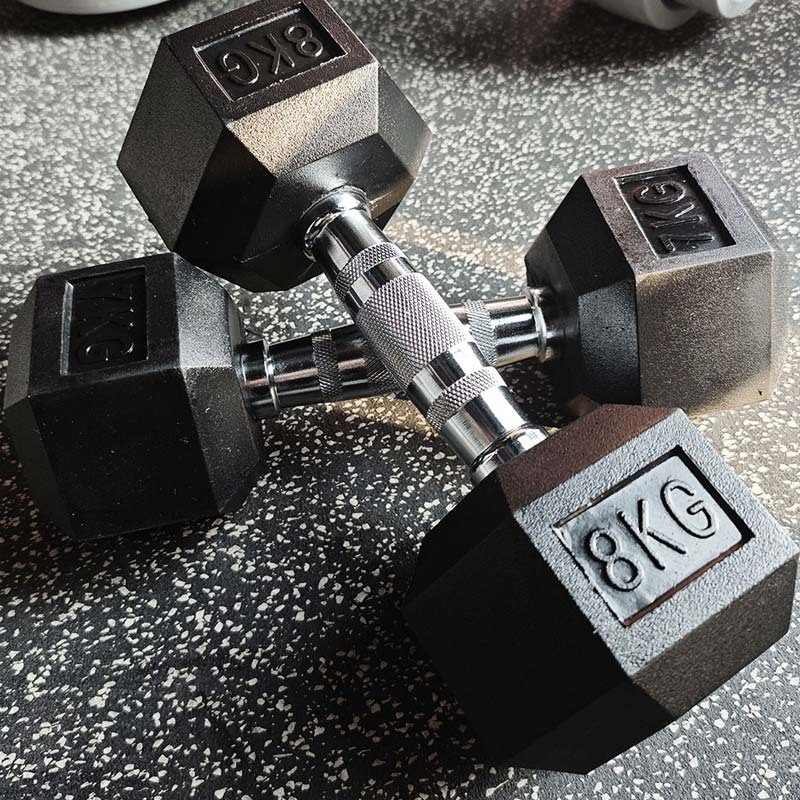
For brands positioning their dumbbells in the premium tier, materials such as chrome-plated steel handles paired with rubber-coated iron heads offer an attractive visual contrast while maintaining structural integrity. Hex-shaped rubber-coated designs — such as the OEM dumbbell production format offered by established manufacturers — are particularly popular because the flat sides prevent rolling, reduce floor damage, and appeal to both home gym users and commercial fitness operators. Brands can request specific hex geometries, handle diameters, and knurling patterns to create a product that feels unmistakably their own.
Branding, Surface Finish, and Packaging Customization
Surface finish and branding integration are areas where OEM dumbbell production allows fitness companies to create strong visual brand identities. Logos can be applied through a range of techniques including laser engraving, paint filling, debossing, or embossed molding directly into the rubber or urethane coating. Each method carries different durability and cost implications. Engraved and molded logos tend to outlast painted alternatives in commercial environments where repeated cleaning and impact exposure are factors.
Color selection in OEM dumbbell production extends beyond mere aesthetics. Many fitness brands use color-coded weight systems — where specific colors are assigned to specific weight increments — to help users quickly identify the correct dumbbell during a workout. OEM manufacturers capable of offering a wide pantone range give brands the freedom to develop proprietary color systems that become part of the brand's visual language. This is particularly valuable for brands selling complete dumbbell sets with accompanying storage racks, where visual cohesion across the full weight range reinforces premium positioning.
Packaging customization is another dimension of OEM dumbbell production that international brands often underestimate. For e-commerce channels, packaging must protect the product during international shipping while also delivering an unboxing experience that reinforces brand values. OEM manufacturers experienced in servicing international fitness brands will have established packaging engineering capabilities, including drop-test-certified carton designs, branded tissue wrapping, and printed inserts. Coordinating packaging development alongside product development — rather than treating it as an afterthought — reduces costly rework and shipping damage claims.
Quality Assurance in OEM Dumbbell Manufacturing
Raw Material Sourcing and Pre-Production Verification
Quality in OEM dumbbell production begins long before a single piece of iron is cast. Reputable OEM manufacturers maintain documented supplier relationships for their primary raw materials — iron, steel, rubber compound, and coating chemicals — and subject incoming materials to standardized inspection protocols. For international fitness brands, understanding how a manufacturer manages its raw material supply chain is a critical due diligence step. Inconsistency in iron composition, for example, can result in weight tolerance variations that violate the specifications buyers rely on for accurate weight denominations.
Pre-production verification typically involves the review and approval of a physical sample — known in manufacturing as a golden sample or counter sample — before any bulk production commences. This sample serves as the physical reference against which all subsequent production units are measured. Brands engaging in OEM dumbbell production for the first time should allocate sufficient lead time for multiple rounds of sample review, particularly for products with complex branding elements or non-standard weight configurations. Rushing through the sampling stage to accelerate time-to-market is one of the most common sources of quality failures in OEM partnerships.
In-Process and Final Inspection Standards
Throughout the production process, experienced OEM manufacturers performing OEM dumbbell production at scale apply in-process quality controls at each stage of the manufacturing workflow. For rubber-coated dumbbells, this includes checking coating adhesion, surface smoothness, color uniformity, and the accurate seating of the metal core within the rubber shell. Weight tolerance verification — confirming that a 10 kg dumbbell falls within an accepted deviation range, typically ±2-3% — is conducted on statistical samples drawn from each production batch.
Final inspection is the last line of defense before products are packed for shipment. International fitness brands typically either rely on the manufacturer's internal QC team, commission an independent third-party inspection agency, or send their own representatives to the factory floor for critical orders. Third-party inspections following the AQL (Acceptable Quality Limit) sampling standard are common practice in OEM dumbbell production for export markets. These inspections generate detailed reports covering visual defects, dimensional accuracy, weight verification, and packaging integrity, giving the brand documentary evidence of product conformity before goods leave the factory.
Logistics and Compliance Considerations for International Fitness Brands
Export Documentation and Regulatory Compliance
Shipping dumbbells internationally is not simply a matter of loading containers. OEM dumbbell production intended for international markets must navigate a range of export documentation requirements and destination-country regulatory standards. Common requirements include certificates of origin, material safety data sheets for rubber compounds and coating materials, and compliance with destination-country regulations governing heavy metals content in rubber products — a consideration particularly relevant for products entering the European Union and North American markets.
Fitness brands sourcing through OEM dumbbell production should confirm that their manufacturer is familiar with the specific compliance frameworks applicable to their target markets. This includes REACH compliance for chemical substances in rubber coatings (relevant for EU sales), California Proposition 65 disclosures (relevant for US sales), and product liability documentation that may be required by retail chain buyers. Manufacturers with established export track records in premium markets will typically have template documentation frameworks already in place, significantly reducing administrative burden on the brand side.
Shipping Logistics, Lead Times, and Inventory Planning
Dumbbells are dense, heavy products, and their logistics profile differs substantially from lighter fitness accessories. Effective OEM dumbbell production planning must account for the shipping economics associated with heavy free weights. Full-container loads (FCL) are the standard shipping format for large dumbbell orders, and optimizing pallet configurations to maximize container utilization directly impacts freight cost per unit. Brands ordering across a broad weight range — for example, sets from 2 kg to 30 kg — should work with their OEM manufacturer's logistics team to develop carton weight and stacking specifications that allow safe, efficient container loading.
Lead times in OEM dumbbell production vary based on order complexity, current factory capacity, and the degree of customization required. Standard rubber hex dumbbell lines with straightforward branding can typically be produced in 45 to 60 days from confirmed purchase order. Heavily customized products involving novel molds, proprietary coating formulations, or new packaging structures may require 90 to 120 days of lead time, particularly if tooling development is involved. International fitness brands operating on seasonal demand cycles — with peaks around January and back-to-school periods — must integrate these lead time realities into their procurement calendars to avoid stock-outs during high-demand windows.
Building a Long-Term OEM Partnership in the Dumbbell Category
Evaluating Manufacturer Capabilities Before Committing
Selecting the right manufacturing partner for OEM dumbbell production is one of the most consequential business decisions a fitness brand will make. Factory audits — either conducted in person or through accredited third-party auditing firms — provide insight into a manufacturer's production capacity, equipment condition, workforce skill levels, and quality management systems. Brands should also review the factory's existing client portfolio and, where possible, request references from comparable international fitness brands that have worked with the manufacturer. A factory's willingness to provide references and facilitate transparent audits is itself a positive indicator of organizational maturity.
Beyond production capability, brands should assess a manufacturer's responsiveness, communication quality, and flexibility in accommodating mid-production adjustments. In OEM dumbbell production, the ability to communicate effectively across time zones and language differences is often what separates a successful long-term partnership from a frustrating transactional relationship. Brands that treat manufacturer relationships as strategic partnerships — sharing forecasts, providing timely feedback on samples, and honoring payment terms — consistently report better service levels and priority access to production capacity during peak periods.
Scaling Production Volume and Product Line Expansion
Successful international fitness brands rarely stay static in their product offerings. As a brand grows, it may need to expand its dumbbell line — adding new weight increments, introducing specialty formats such as adjustable or rubber hex dumbbells, or developing premium sub-lines targeting specific fitness segments. An OEM manufacturer with the scale and technical breadth to grow alongside the brand offers significant strategic value compared to one that can only serve narrow specifications.
OEM dumbbell production at scale introduces economies of unit cost that improve margin structure over time. Brands that demonstrate consistent ordering patterns and growing volumes can negotiate preferential pricing, priority scheduling, and early access to new manufacturing innovations as part of their commercial relationship. This dynamic rewards brands that invest in building genuine partnerships rather than treating OEM dumbbell production as a purely transactional procurement exercise. Over a multi-year horizon, the cumulative impact of these advantages — in cost, quality consistency, and speed to market — can meaningfully differentiate a brand's competitive position in the global fitness equipment landscape.
FAQ
What is the typical minimum order quantity for OEM dumbbell production?
Minimum order quantities (MOQs) in OEM dumbbell production vary by manufacturer and product type, but for rubber-coated hex dumbbells, MOQs commonly range from 500 to 1,000 kg of product per SKU, or a specified unit quantity per weight denomination. Brands ordering a full dumbbell range across multiple weight increments often negotiate a blended MOQ across the complete set, which can make initial orders more accessible. It is important to discuss MOQ structures early in supplier conversations to understand how they interact with your initial inventory budget and storage capacity.
How long does the sampling process take for a new OEM dumbbell product?
For a standard OEM dumbbell production project using existing molds and established materials, the sampling process typically takes 15 to 25 business days from the time the manufacturer receives confirmed technical specifications and branding artwork. If new tooling is required — such as a custom hex head mold or a proprietary handle shape — additional time of 30 to 45 days for tooling fabrication should be anticipated. Brands should build at least two rounds of sample review into their project timelines to account for revisions before approving mass production.
What certifications should I look for when choosing an OEM dumbbell manufacturer?
When evaluating partners for OEM dumbbell production, brands serving international markets should prioritize manufacturers holding ISO 9001 quality management certification as a baseline indicator of systematic quality controls. For products entering the EU, evidence of REACH-compliant rubber formulations is essential. For US markets, manufacturers familiar with ASTM and CPSC relevant standards, as well as California Proposition 65 disclosure requirements, offer a compliance advantage. Social compliance certifications such as BSCI or SA8000 are increasingly required by large retail chains and add credibility when pitching to major sporting goods retailers.
Can OEM dumbbell production accommodate both pound and kilogram weight denominations?
Yes, this is a standard capability for experienced OEM manufacturers serving international fitness brands. Most established facilities can produce the same dumbbell design with either engraved, embossed, or paint-filled weight denominations in both pounds and kilograms within the same production run. The key requirement is that the brand specifies the denomination system clearly in the product specifications submitted before sampling. Some brands operating in genuinely dual-market environments request that both pound and kilogram values appear on the same dumbbell head, which is achievable with appropriate mold or engraving design. Confirming this capability during factory qualification is important for brands targeting multiple geographic markets simultaneously.
Table of Contents
- The Foundation of OEM Dumbbell Production
- Customization Options Available Through OEM Manufacturing
- Quality Assurance in OEM Dumbbell Manufacturing
- Logistics and Compliance Considerations for International Fitness Brands
- Building a Long-Term OEM Partnership in the Dumbbell Category
-
FAQ
- What is the typical minimum order quantity for OEM dumbbell production?
- How long does the sampling process take for a new OEM dumbbell product?
- What certifications should I look for when choosing an OEM dumbbell manufacturer?
- Can OEM dumbbell production accommodate both pound and kilogram weight denominations?